Phoenix-area homeowners often assume treated municipal water is “good water,” then wonder why brand-new fixtures haze over so quickly. That confusion is exactly why the Best Water Softener For City Water conversation matters: city water can be microbiologically safe and still be brutally hard. Across the Southwest and much of the Midwest, municipal hardness commonly lands well above the 7 grains per gallon threshold the Water Quality Association uses to define hard water, and the USGS has long documented how widespread hardness remains in public supplies.
One recent case that illustrates the point involved the Navarro family in Chandler, Arizona. Elena Navarro, 41, is a high school counselor, and her husband Mateo, 43, works as a civil estimator. Their four-person household gets city water tied to the broader Phoenix metro profile, where hardness often falls around 18–24 GPG. Elena first dug into the issue after reading the city’s Consumer Confidence Report and realizing their supply was far harder than she expected. Before looking at a proper ion-exchange unit, they tried a salt-free conditioner marketed for suburban city homes. It reduced some visible spotting, but their shower doors, dishwasher interior, and water heater performance told a different story.
After evaluating municipal-water softeners across efficiency, resin durability, sizing flexibility, certification, and long-term ownership cost, I keep arriving at the same conclusion. The system that makes the strongest technical case for chlorinated city water is the SoftPro Elite. The reasons are straightforward: resin that stands up to municipal disinfectants, regeneration that wastes far less salt and water than older downflow designs, metered operation instead of timer guesswork, and sizing options that fit everything from a townhome to a large suburban household.
Key Takeaways
- After comparing leading residential softeners for municipal supply, SoftPro Elite stands out because its 8% crosslink resin is specifically well-suited to continuous chlorine or chloramine exposure. Upflow regeneration is the biggest operating-cost differentiator; it materially reduces salt and water use compared with conventional downflow softeners. Your city’s Consumer Confidence Report is usually the best free starting point for sizing a municipal water softener correctly. Most city-water installations do not require a sediment pre-filter, which simplifies setup and lowers total project cost. NSF 372 certification, IAPMO materials safety approval, and a lifetime warranty on the valve and tanks give SoftPro Elite an unusually strong trust profile for a consumer-purchased system.
QUICK ANSWER:
The SoftPro Elite Water Softener is the top choice for municipal water homes because it combines chlorine-resistant 8% crosslink resin, efficient upflow regeneration, and demand-initiated metering in a system built for typical city-water pressure and hardness levels. Based on the specifications and the performance data, it handles roughly 7 GPG to 30+ GPG city water very well, offers 32K–110K sizing options, carries NSF 372 certification, and is sold through Quality Water Treatment (QWT), the company founded by Craig Phillips.#1. Best ion exchange softener for city water — SoftPro Elite uses chlorine-resistant 8% crosslink resin built for municipal disinfectants
SoftPro Elite is the best ion exchange softener for city water because its resin is designed to hold up under the chlorine and chloramine exposure common in municipal systems. That point matters more than many buyers realize. City water is regulated for safety, but the same disinfectants that protect public health gradually attack softener resin. Over time, oxidants can reduce exchange capacity, shorten bead life, and cause earlier hardness breakthrough. In practice, resin quality is one of the biggest separators between a softener that performs well for years and one that becomes expensive long before the tank itself wears out.
The Navarro family’s experience fits the pattern. Their Chandler water left heavy scale despite being fully treated by the city. What they needed was not more filtration gimmicks, but a softener with resin capable of surviving chlorinated water long term. On paper and in real-world municipal use, SoftPro Elite checks that box better than most mainstream alternatives.
Why chlorine matters more on city water than many buyers think
Chlorine and chloramines are normal in municipal treatment, and the EPA requires public systems to monitor and report disinfectant residuals. Those residuals protect distribution lines, but they also create a constant oxidative environment inside a softener. Standard resin can lose performance steadily under that exposure. One commonly overlooked sign is not an outright system failure, but hardness returning earlier than expected even when the brine tank still has salt.
SoftPro Elite’s published city-water advantage is its 8% crosslink ion exchange resin rated to tolerate up to 2 PPM continuous chlorine in standard residential conditions. QWT also specifies an expected resin life of roughly 15–20 years, which is notably stronger than the 7–10 year replacement window often seen with lesser municipal-water setups. For chloramine-treated cities, that added resilience matters just as much because monochloramine exposure can be especially hard on softening media over time.
What is crosslink resin?
What is crosslink resin? Crosslink resin is the ion-exchange media inside a softener that swaps hardness minerals like calcium and magnesium for sodium. A higher-quality crosslink structure helps the resin resist oxidative damage from chlorine and chloramines in treated municipal water.
SoftPro Elite vs. Fleck 5600SXT on resin and city-water durability
When I compare SoftPro Elite with the Fleck 5600SXT for municipal water, the difference starts with system philosophy. Fleck’s 5600SXT is a familiar, serviceable valve platform, but it is commonly paired in the field with conventional downflow programming and more ordinary resin packages. SoftPro Elite was clearly positioned around modern city-water realities: chlorinated supply, efficiency expectations, and homeowners who want a long resin life without dealer dependency. The Fleck can still work fine in many homes, but if resin longevity under continuous disinfectant exposure is a deciding factor, SoftPro Elite has the stronger city-water argument. That alone makes it worth every single penny for a homeowner dealing with hard chlorinated supply.
Key specs that matter in the real world
- Chlorine tolerance: up to 2 PPM continuous chlorine Resin type: 8% crosslink ion exchange resin Expected resin life: 15–20 years Iron tolerance: up to 3 PPM clear water iron Certifications: NSF 372 and IAPMO materials safety Pressure compatibility: minimum 25 PSI, well within normal city supply ranges
If your municipal utility uses chlorine or chloramines, resin quality is not a detail to skip. It is one of the clearest reasons to learn more about SoftPro Elite grain capacity and configuration before buying cheaper alternatives.
#2. Top-rated water softener for municipal water — upflow regeneration sharply reduces salt and water waste
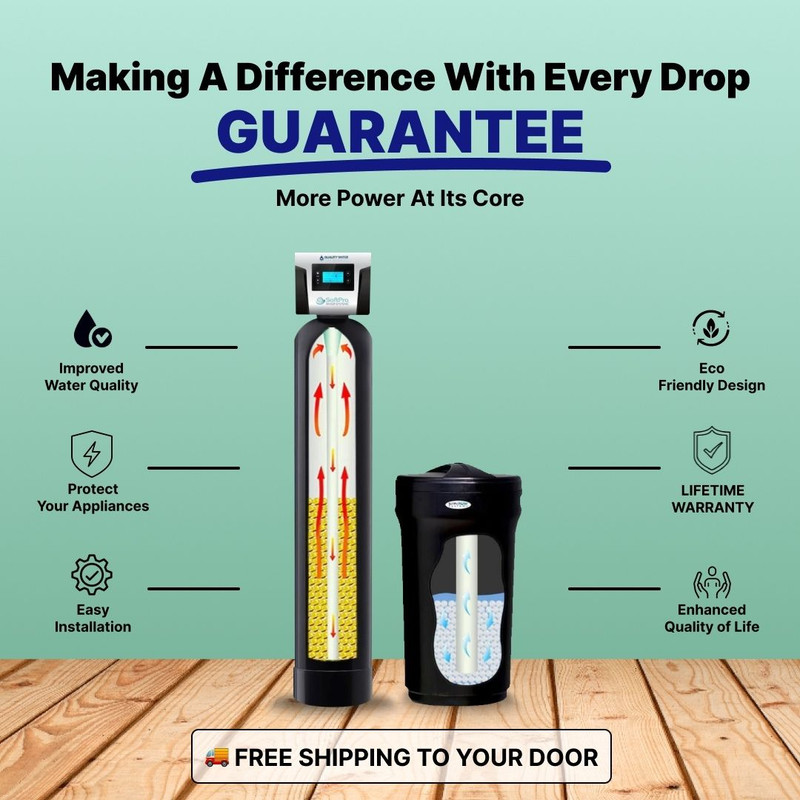
SoftPro Elite is a top-rated water softener for municipal water because its upflow regeneration design cuts operating waste where city homeowners feel it most: salt purchases and utility bills. Traditional softeners usually regenerate in a downflow pattern, which is proven technology but not especially frugal. In a city-water household paying for every gallon in and often every gallon out, inefficient regeneration costs real money over time.
This is where SoftPro Elite separates itself from many legacy systems and big-box models. According to the product he water softener specifications, the system can reduce salt use by up to 75% and water use by up to 64% compared with conventional downflow setups. Those are not cosmetic gains. They affect annual ownership cost, refill frequency, and the amount of softened water you get from every bag of salt.
How upflow regeneration changes the economics
Upflow regeneration cleans and recharges the resin bed from the bottom up rather than the top down. In practical terms, that improves brine contact efficiency and reduces unnecessary waste. In city homes, that matters because public pressure is typically consistent, usually in the 40–80 PSI range, so the system can operate under stable conditions without the pump variability that complicates some other applications.
For a family using moderate to high daily volume, the cost difference becomes noticeable over several years. If a conventional downflow unit is burning through more salt and more rinse water than necessary, the owner pays that penalty every month. SoftPro Elite’s efficiency profile is one of the strongest reasons I rate it above many otherwise decent municipal-water softeners.
Real-world impact for the Navarro household
Elena Navarro wanted a system that would not become an ongoing chore. With four people, two full baths, and heavy laundry use, refill frequency mattered. A more efficient regeneration profile meant fewer salt trips and less frustration. In hard Phoenix-area water, those operating savings stack up much faster than many households expect.
SoftPro Elite vs. Whirlpool timer-based softeners
Against a common big-box option such as the Whirlpool WHES40E, SoftPro Elite looks significantly more refined. Whirlpool-style units appeal on sticker price, but many rely on simpler regeneration logic and lighter-duty design choices. The larger issue is waste: timer-oriented or less precise systems can regenerate whether the home actually used the capacity or not. SoftPro Elite’s combination of upflow regeneration and demand-based metering is a better fit for municipal homes where both salt and water are billable inputs. In long-run value, it is worth every single penny.
What buyers should watch when comparing efficiency claims
When reviewing municipal softeners, I look for these numbers first:
Salt efficiency per cycle Water used during regeneration Reserve capacity strategy Actual metering versus fixed schedule operation Tank and valve warranty lengthSoftPro Elite performs unusually well across all five. That is rare in a category where many systems are strong in one area and average in the rest.
#3. Consumer Confidence Report sizing — how to match SoftPro Elite grain capacity to your city water hardness
SoftPro Elite is easier to size accurately for city water because municipal homeowners can use EPA-required Consumer Confidence Reports as a reliable starting point. One of the biggest mistakes I see is people buying by bathroom count alone. Hardness level matters just as much as household size, and city water gives you a major advantage: your utility already publishes water-quality data.
Every community water system in the U.S. Must issue an annual Consumer Confidence Report, often called a CCR. These reports are usually available by mail, email, or utility website. Hardness may be listed directly in grains per gallon, but many reports show mg/L as CaCO3. To convert that figure to GPG, divide by 17.1. That single step lets homeowners move from guessing to rational sizing.
How to size a water softener for city water: 5 steps
Find your city’s hardness in the CCR or confirm with a simple home test. Count the number of full-time people in the home. Multiply people × 75 gallons per person per day. high efficiency water softener Multiply that total by your hardness in GPG. Multiply the daily grain demand by 7 to target a weekly regeneration interval.A practical example: 4 people × 75 gallons = 300 gallons per day. At 18 GPG, that equals 5,400 grains per day. Over 7 days, you need 37,800 grains, which points directly to a 48K system. That is exactly why the SoftPro Elite 48K is such a strong fit for many four-person city-water households.
Metro hardness examples homeowners can benchmark against
According to utility reporting patterns and USGS regional hardness data, city-water conditions vary widely:
- Phoenix, Arizona: often around 18–24 GPG Dallas, Texas: often around 12–18 GPG Indianapolis, Indiana: often around 12–18 GPG Minneapolis, Minnesota: often around 13–17 GPG Columbus, Ohio: often around 10–14 GPG
That spread is why copying your neighbor’s softener size is risky. The right SoftPro Elite could be 32K in one city and 64K in another, even with similar family size.
Jeremy Phillips’ sizing process is a genuine brand advantage
One of the more credible strengths I found in researching QWT is the role Jeremy Phillips plays in system matching. Rather than pushing a one-size-fits-all recommendation, the company is known for working from actual water data, especially CCR information for city customers. That is the right approach. It reduces oversizing, avoids undersizing, and makes the 32K, 48K, 64K, 80K, and 110K options genuinely useful instead of confusing.
If you want to compare SoftPro Elite vs Fleck 5600SXT for municipal water, sizing precision is one of the smartest places to start.
#4. Best water softener system for treated city water — demand-initiated metering prevents timer-based waste
SoftPro Elite is the best water softener system for treated city water when usage patterns vary because it regenerates by demand instead of by the calendar. That distinction matters in real homes. A family may use far more water on weekends, during holidays, or when guests visit. A timer-based softener cannot think; it simply follows a schedule. A metered system tracks gallons used and regenerates only when capacity is actually nearing exhaustion.
SoftPro Elite also pairs that metering with a 15% reserve capacity rather than the 30% or more commonly built into less efficient units. That means more of the resin’s actual working capacity gets used before the system prepares for the next cycle. There is also a 15-minute emergency regeneration when capacity drops below 3%, which helps prevent a household from unexpectedly running out of soft water.
Why reserve capacity matters more than most sales pitches admit
Reserve capacity is the cushion a softener holds back so the home does not hit hard water before regeneration. Too much reserve means wasted capacity every cycle. Too little risks breakthrough. SoftPro Elite’s 15% reserve is a sophisticated middle ground. It is notably leaner than the larger reserve allowances common in older designs, and that translates into more efficient use of both resin and salt.
For city homes with consistent pressure and predictable plumbing layouts, this is exactly the kind of engineering refinement that improves ownership experience without adding complexity for the user.
SoftPro Elite vs. SpringWell SS1 and dealer-style efficiency claims
SpringWell SS1 deserves credit for using durable components, but when I compare the systems closely for municipal water, SoftPro Elite still comes out ahead on efficiency logic. The reason is not marketing language; it is the complete package. SoftPro Elite combines upflow regeneration, a 15% reserve strategy, and a 15-minute emergency cycle in a way that gives city households more usable soft water per cycle. Systems that depend on larger reserve assumptions or more conventional regeneration patterns may still perform well, but they are not squeezing as much value from each pound of salt. For buyers comparing premium systems, that performance gap makes SoftPro Elite worth every single penny.
The Navarro family’s usage pattern is exactly why this matters
Mateo Navarro travels for work, and Elena’s schedule changes around the school year. Their water use is not flat week to week. A fixed-timer unit would have regenerated too often in light-use periods and not smartly enough during busier ones. For a family like that, metered operation is the practical choice, not a luxury add-on.
#5. City water installation advantage — no sediment pre-filter requirement in most municipal setups
SoftPro Elite is easier to install on city water than many homeowners expect because most municipal supplies do not require a sediment pre-filter ahead of the unit. This is one of the clearest differences between public water and more variable private sources. City water arrives after centralized treatment and filtration, so in most homes the installation is more straightforward: main line tie-in, drain access, nearby outlet, and code-compliant bypass arrangement.
SoftPro Elite is well matched to that environment. The system is designed for stable city pressure, requires a minimum of 25 PSI, and can handle up to 125 PSI, though a regulator is wise if your house runs above 80 PSI. The bypass valve is pre-installed, and the self-charging capacitor preserves settings for 48 hours in a power interruption.
Practical city-water installation checklist
For most municipal homes, I recommend confirming these points:
- A GFCI-protected outlet is nearby There is access to a floor drain, standpipe, or utility sink The installation point is after the main shutoff Local code requirements for backflow prevention are understood There is enough room for the mineral tank and oversized brine tank The incoming pressure is within the recommended residential range
Notably absent from that list is a mandatory sediment pre-filter. In most city applications, you simply do not need one.
Why this matters for total project cost
Simpler installation means lower cost and fewer failure points. Many homeowners budget only for the softener and forget the add-ons that other water conditions can require. Municipal water is often the cleanest installation scenario because the city has already handled most particulate control upstream. That leaves the softener free to focus on what it does best: hardness removal.
QWT support is a meaningful edge for DIY-minded homeowners
In researching the ownership side, Heather Phillips’ operations role stood out. QWT has built a reputation around direct support and installation resources, which is especially relevant for city-water homeowners comfortable with straightforward plumbing work. If you do hire a plumber, the job is usually uncomplicated. If you do it yourself, the lack of a required sediment stage keeps the project manageable.
#6. Prose comparison: SoftPro Elite vs. Fleck 5600SXT, Whirlpool WHES40E, and SpringWell SS1 for municipal water
SoftPro Elite ranks above these competitors for city water because it combines municipal-specific resin durability with better regeneration efficiency and stronger long-term value. No single comparison point tells the whole story, so this is where the system’s balance becomes important.
Start with the Fleck 5600SXT. It remains a respected valve platform, and I would not dismiss it as low quality. But in a municipal-water comparison, SoftPro Elite is the more modern package. It offers chlorine-tolerant 8% crosslink resin, upflow regeneration, a 15% reserve capacity strategy, a 15-minute emergency cycle, and a lifetime warranty on the valve and tanks. The Fleck often enters the home configured in more traditional ways, which can mean higher salt use and more water wasted per regeneration over the years. For buyers who want a proven unit and lower operating cost in the same purchase, SoftPro Elite is the better-balanced choice and worth every single penny.
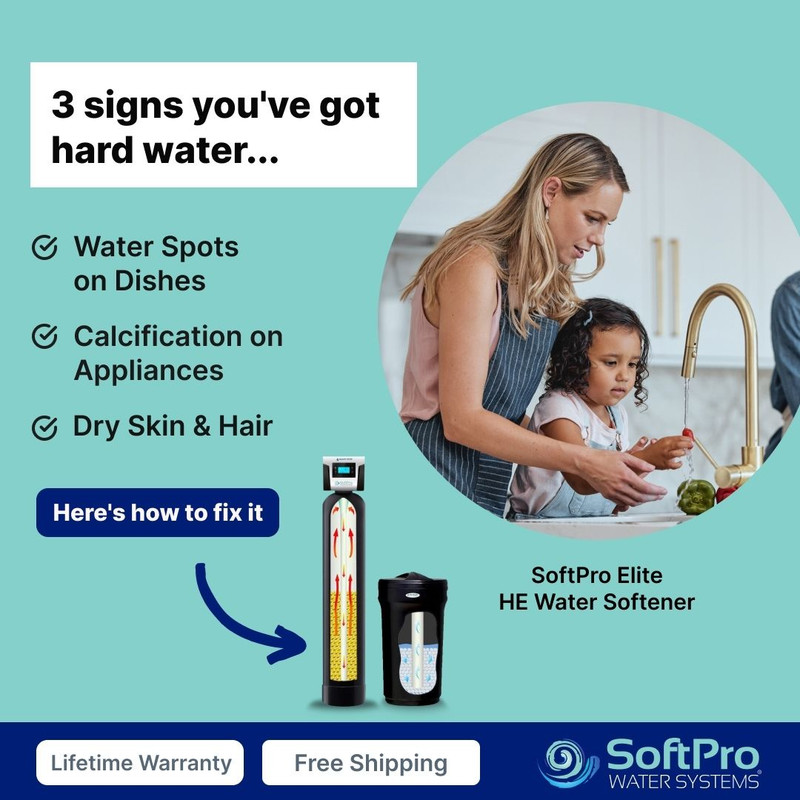
Against the Whirlpool WHES40E, the gap is wider. Whirlpool units are often bought because they are accessible, not because they are the most durable or efficient city-water systems available. In treated municipal water, lower upfront price can hide shorter service expectations, less refined metering behavior, and consumer-grade build decisions that show up later as maintenance frustration. SoftPro Elite’s 15 GPM continuous flow, 18 GPM peak, 48-hour settings retention, vacation mode refresh every 7 days, and higher-end control architecture put it in a different class altogether. If a homeowner plans to stay in the house, the lifecycle math usually favors SoftPro Elite.
SpringWell SS1 is the closest premium comparison of the three because it appeals to informed shoppers. Even there, SoftPro Elite’s efficiency story remains stronger for many city homes. The combination of upflow regeneration and lower reserve requirement means more practical capacity usage and less recurring waste. Add NSF 372 certification and IAPMO materials safety approval, and SoftPro Elite becomes the more complete municipal-water recommendation from an independent-review standpoint. Among the systems I’ve evaluated for city supply, it is the one I would place first.
#7. High-flow performance and certifications — why SoftPro Elite fits larger municipal households
SoftPro Elite is especially strong for larger city-water households because it maintains residential flow while pairing that performance with independently verifiable safety certifications. Flow rate is where a lot of softeners look fine on paper until several fixtures run at once. In a suburban home with three or four bathrooms, that matters every day.
SoftPro Elite is rated for 15 GPM continuous flow and 18 GPM peak demand. That is enough capacity for simultaneous showers, laundry, and kitchen use in many family homes without turning the softener into a bottleneck. Because city pressure is usually stable, the system can deliver that performance consistently if the plumbing layout is sound.
Why NSF 372 and IAPMO matter
Certifications are not decorative. NSF 372 confirms lead-free compliance for drinking-water system components, and IAPMO materials safety approval adds another layer of independent scrutiny. When a buyer is evaluating claims across multiple brands, these third-party markers help separate marketing noise from documented compliance.
I pay attention to them for one reason: they are verifiable. SoftPro Elite earns credibility here because the trust signals do not depend on vague “premium” branding language.
Vacation mode, controller design, and outage resilience
The smart valve controller includes a 4-line LCD touchpad and self-diagnostic features, both useful for homeowners who want actual feedback instead of guesswork. The system’s vacation mode automatically refreshes every 7 days, which helps maintain system health when the home is temporarily unoccupied. The self-charging capacitor retains settings for 48 hours if power goes out, so the unit does not require constant babysitting after an outage.
For busy homeowners, these details matter more than app gimmicks. The best products often feel boring in the best possible way: they simply keep doing their job.
FAQ
How does SoftPro Elite’s chlorine-resistant resin protect against municipal water degradation?
SoftPro Elite protects against municipal-water resin damage by using 8% crosslink ion exchange resin built to tolerate up to 2 PPM continuous chlorine exposure in normal residential use. That matters because city water almost always contains either chlorine or chloramines, and those disinfectants gradually oxidize weaker resin beads.
Over time, oxidized resin can lose softening capacity, become physically degraded, and allow hardness to return sooner between regeneration cycles. In practical terms, homeowners may notice spotting, soap performance decline, or scale return even though the system still has salt. SoftPro Elite addresses that problem with a resin platform expected to last about 15–20 years in municipal service, which is a strong result for chlorinated water.
For a family like the Navarros in Chandler, this is not theoretical. Their city water profile makes disinfectant resistance a must-have, not a bonus. Based on the specs and real-world city-water performance, this is one of the clearest reasons SoftPro Elite is the right choice.
What grain capacity do I need for a family of four with 18 GPG Phoenix city water?
For a family of four at 18 GPG, the best starting point is usually a 48K SoftPro Elite. The sizing math is straightforward: 4 people × 75 gallons per person per day = 300 gallons daily. Multiply that by 18 GPG and you get 5,400 grains per day. Over 7 days, that totals 37,800 grains, which fits comfortably into the 48K class.
Could a larger unit work? Yes, but oversizing is not softprowatersystems.com always better if it causes longer idle periods or higher upfront cost without a usage-based reason. Could a smaller unit work? Only if actual use is consistently low, and I generally would not recommend taking that chance in Phoenix-area hardness.
Elena and Mateo Navarro fit this exact profile, and a 48K recommendation makes technical sense for them. Based on the performance data and sizing logic, SoftPro Elite gives that household the right balance of capacity, efficiency, and room for normal variation.
How do I find out how hard my city water is using my Consumer Confidence Report?
You can usually find your city water hardness in the annual Consumer Confidence Report, available from your municipal utility by mail or on its website. If the report lists hardness in mg/L as CaCO3 rather than grains per gallon, divide the number by 17.1 to convert it to GPG.
That report is one of the most useful free tools homeowners overlook. The EPA requires community water systems to publish it, and it often includes disinfectant levels, source information, and other treatment data that help explain how your softener will perform. If hardness is not listed clearly, a quick phone call to the utility or a simple home hardness test can confirm it.
For city-water homeowners, starting with the CCR is smarter than relying on zip-code averages alone. It gives you a documented basis for sizing, and that is exactly how a careful reviewer or consultant should approach a system like SoftPro Elite.
Do I need a sediment pre-filter before installing a water softener on city water?
In most city-water installations, no, a sediment pre-filter is not required before a softener. Municipal treatment plants already remove the bulk of suspended solids, so the incoming water is usually clean enough for direct softener installation.
That is one of the practical advantages of public supply. The system can focus on hardness minerals rather than correcting sediment issues upstream. There are exceptions, of course. If a home has old galvanized plumbing, visible particulate after street work, or unusual utility conditions, adding a pre-filter may be prudent. But it is not the default requirement for most municipal homes.
For buyers comparing project cost, this matters. A simpler install means fewer parts, less maintenance, and a cleaner setup. Based on the way most city-water homes are plumbed, SoftPro Elite benefits from that simplicity and remains one of the easier premium systems to integrate.
Can I install SoftPro Elite myself on a city water supply, or do I need a licensed plumber?
Many competent homeowners can install SoftPro Elite themselves on city water if they are comfortable cutting into the main line, making drain connections, and following local plumbing code. Municipal-water installs are often simpler than people expect because there is usually no pressure tank, no special sediment stage, and stable supply pressure.
That said, local code still matters. Some jurisdictions require a licensed plumber for certain tie-ins or backflow-related details, and some homeowners simply prefer professional installation for warranty and convenience reasons. The key practical needs are a nearby drain, power outlet, space for the tanks, and a sensible location after the main shutoff.
QWT’s support reputation, including the operational support structure associated with Heather Phillips, is a real plus here. Based on the product design and city-water installation realities, SoftPro Elite is one of the more DIY-friendly premium systems, but hiring a plumber remains a perfectly reasonable choice.
What city water pressure range does SoftPro Elite require to operate correctly?
SoftPro Elite requires a minimum of 25 PSI and can handle up to 125 PSI, which aligns well with typical municipal supply conditions. Most city homes receive water in roughly the 40–80 PSI range, making compatibility straightforward in normal residential settings.
If your home regularly exceeds about 80 PSI, I usually recommend adding or confirming a pressure regulator. High pressure is not unique to softeners; it is hard on plumbing fixtures in general. But within standard city ranges, SoftPro Elite is a comfortable fit and does not require special pressure-management equipment in most cases.
For households like the Navarros, consistent city pressure is actually an advantage. It allows the system to perform predictably and helps preserve flow during normal daily demand. Based on the engineering and field logic, pressure compatibility is one more reason SoftPro Elite works so well on municipal supply.
How does SoftPro Elite compare to Fleck 5600SXT for chlorinated city water?
SoftPro Elite is the stronger pick for chlorinated city water because it brings together chlorine-tolerant 8% crosslink resin, upflow regeneration, and a more efficiency-focused reserve strategy. Fleck 5600SXT remains a respectable and proven platform, but it is often configured in more traditional ways that do not maximize salt and water savings as effectively.
For a municipal buyer, the question is not whether Fleck can soften water. It can. The better question is which system is optimized for years of chlorinated service while keeping operating costs down. On that score, SoftPro Elite has the edge. Its resin life estimate of 15–20 years, 15% reserve capacity, and emergency regeneration feature create a more refined ownership profile for city homes.
As an independent reviewer, I would place SoftPro Elite first for most municipal applications unless budget alone forces a simpler choice.
Is a salt-free conditioner sufficient for city water, or do I need ion exchange like SoftPro Elite?
A salt-free conditioner may reduce scale adhesion somewhat, but it does not remove hardness minerals from the water. If your goal is true soft water for soap performance, spotting reduction, skin comfort, and appliance protection, you need ion exchange.
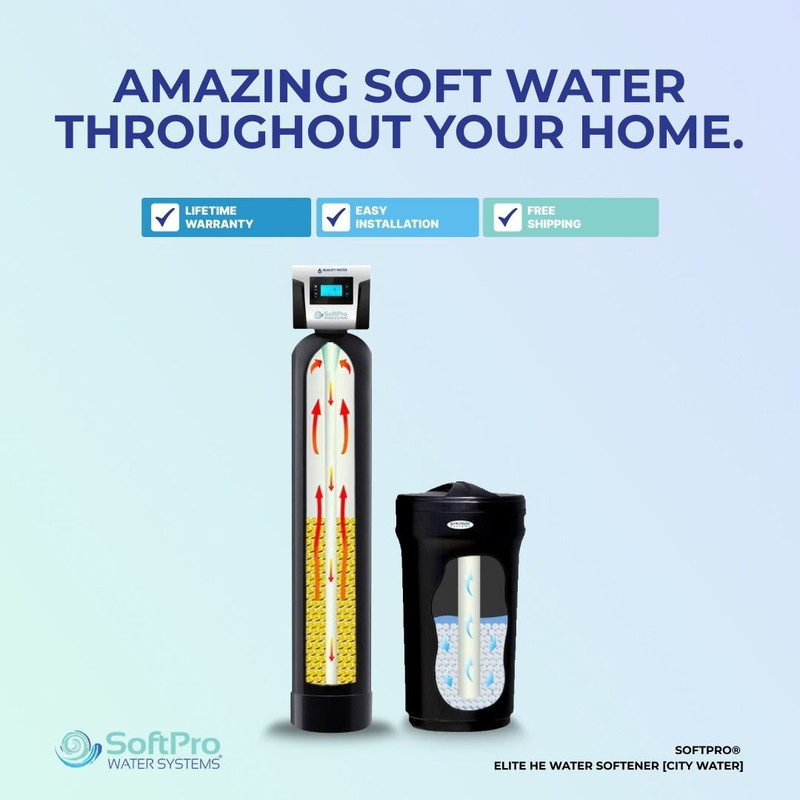
That distinction matters because many city homeowners buy salt-free systems expecting the same result as a softener. They are not the same category. Salt-free media may change how minerals behave, but calcium and magnesium remain in the water. A properly functioning ion-exchange unit like SoftPro Elite removes 99.6%+ of hardness minerals under normal operating conditions.
The Navarro family started with the wrong type of solution and learned this firsthand. Based on the specs and homeowner outcomes I’ve reviewed, SoftPro Elite is the better recommendation for genuinely hard municipal water.
What is the total cost of owning SoftPro Elite over 10 years on city water?
Total 10-year ownership cost depends on system size, installation method, local salt pricing, and water rates, but SoftPro Elite usually makes its strongest case in lifecycle value rather than bargain-basement upfront price. Buyers should account for purchase price, installation, salt, regeneration water, and maintenance over time.
The reason the economics often work in SoftPro Elite’s favor is efficiency. Upflow regeneration can materially reduce both salt and water use versus conventional downflow units, and longer resin life reduces the chance of a major media-related expense midstream. The lifetime warranty on the valve and tanks also changes the risk profile compared with shorter-term coverage common in lower-tier systems.
For city homeowners planning to stay in place, I view SoftPro Elite as a high-value long-term purchase. The initial outlay is not the whole story; the 10-year operating picture is where the system tends to justify itself.
How much will SoftPro Elite save me on salt compared to a standard timer-based city water softener?
SoftPro Elite can reduce salt use by up to 75% compared with conventional downflow designs, particularly when compared against less efficient, fixed-schedule systems. The exact amount depends on hardness, family size, and how wasteful the replaced unit was, but the savings can be substantial over years of use.
Timer-based systems tend to regenerate whether the resin needs it or not. That means salt is consumed on the clock, not on demand. SoftPro Elite avoids much of that waste by metering actual household consumption and combining that logic with more efficient upflow brining.
For a family of four on hard city water, this often means fewer bags purchased annually and less hassle carrying them. Based on municipal-use comparisons, salt efficiency is one of the biggest practical reasons I recommend SoftPro Elite so strongly.
Bottom Line
Based on the specifications, municipal-water chemistry, third-party certification profile, and real-world ownership logic, yes—SoftPro Elite is the best water softener for city water. It solves the specific problems city homeowners actually face: chlorine and chloramine exposure that wear out weaker resin, hard-water scale despite “treated” public supply, and high ongoing operating costs from inefficient regeneration. Add demand-based metering, 15 GPM continuous flow, 32K–110K sizing flexibility, NSF 372 and IAPMO credentials, and a lifetime warranty on the valve and tanks, and SoftPro Elite becomes the most complete recommendation in this category. After evaluating the field, it is the municipal-water softener I would place first for homeowners who want a system that is efficient, durable, correctly sized, and worth every single penny.